Apprentices in the Playroom: The Quiet Power of Mixed-Age Grouping

There is a bench near the coat pegs in many Montessori nursery rooms. It is not a special bench. It is just a place to sit while you wrestle with a zip, a welly, a shoelace. And it is where some of the most quietly impressive learning in the building happens.
A two-year-old sits on one end, shoes in hand. A four-year-old sits on the other, working through the familiar sequence: loop, wrap, pull, tighten. The two-year-old is not joining in. They are watching. Their eyes follow the lace. They see the four-year-old get it wrong, sigh, undo it, try again. They see the whole messy business of becoming capable.
It would be easy to call that cute and move on. But in a mixed-age Montessori room, that moment is not an accident. It is the curriculum doing its work without a lesson plan in sight.
The room as a workshop, not a race
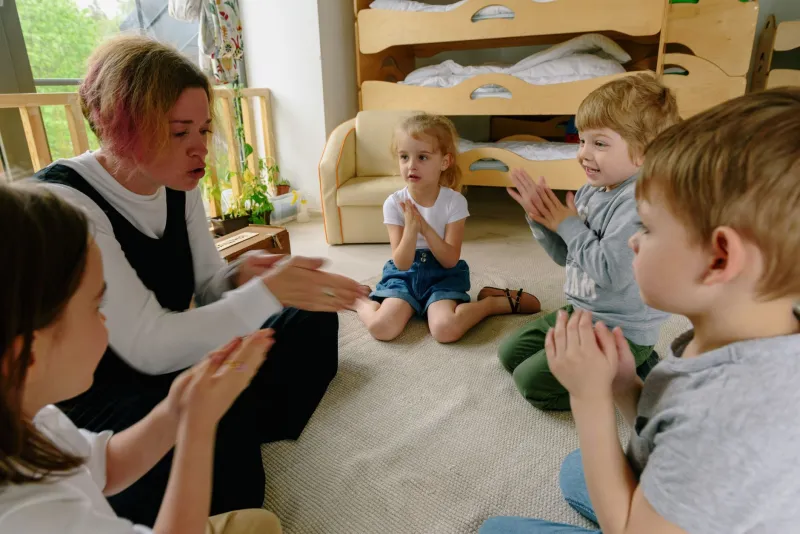
Most UK nurseries group children by age. Montessori settings often do not. At Little Oaks, children from roughly two to five share a room, a rhythm and a set of shelves. The oldest are not kept back, and the youngest are not left to fend for themselves. They are simply part of a vertical community, the way children have grown up alongside siblings and neighbours for most of human history.
In that room, the four-year-old is not a teacher. They are an older child doing their own work, with a younger audience nearby. The two-year-old is not a pupil. They are a researcher, gathering information about how laces work and how frustration is survived. Learning moves sideways as often as it moves down from an adult.
What parents worry about — and what we actually see
The first question many parents ask about mixed-age rooms is whether the younger children get overlooked. It is a fair worry. In a busy room, the loudest and most capable children can soak up attention. But a well-prepared Montessori room gives the youngest child something an adult cannot always provide: a steady supply of slightly older models who are just one step ahead.
A two-year-old does not need a grown-up to demonstrate every skill. They need to see a four-year-old carry a tray, pour water, roll a mat, and put on a coat. That is close enough to be inspiring and far enough ahead to be worth watching. The adult is still there, observing and stepping in when needed, but the child's attention is often on another child.
The second worry is the opposite: will my older child be held back by spending their day with toddlers? In practice, mixed-age rooms ask older children to do something quite demanding. They consolidate what they know by explaining it, demonstrating it or simply being calm and competent while a younger child watches. That is not babysitting. It is a form of mastery. And older children still have their own challenging work — the maths materials, the writing, the long projects — with adults who know exactly where they are up to.
Imitation is not copying — it is research
When a younger child watches an older one tie a shoe, they are not being lazy or passive. They are gathering data. They are noticing the order of the steps. They are seeing that the lace does not always behave. They are watching what happens when the older child gets stuck: do they ask for help, try again, leave it for a moment, come back?
In Montessori terms, this is the absorbent mind at work. The child takes in the whole scene — the effort, the setback, the recovery — not just the finished bow. We protect that long look. We do not rush in with a cheerful 'Let me show you how to do it' the second a younger child pauses to watch. We give them a minute to be an apprentice.
The older child's hidden curriculum
For the older child, the bench is a different kind of lesson. Tying your own shoes is one thing. Tying them while a two-year-old watches is another. Suddenly you have to slow down. You have to remember the steps. You might have to say them out loud. You might fail in front of an audience and try again anyway.
That is metacognition — thinking about how you think — and it is far more valuable than a gold star for speed. It also builds a particular kind of leadership that has nothing to do with being bossy. It is the quiet pride of being the person who knows how to do something and is willing to let someone else watch.
Three small ways to echo it at home
You do not need a mixed-age nursery at home to give your child a taste of vertical learning. Try these:
- Arrange mixed-age play. Cousins, neighbours, friends with children of different ages — even a 45-minute playdate with a four-year-old and a two-year-old can do the job. Resist the urge to organise activities for every minute. Let them watch each other.
- Give an older sibling one small expert job. Not all the jobs. One. Setting the table, fetching the dustpan, showing a younger child where the cups live. Then step back and let them be the one who knows.
- Narrate your own learning. Children learn from watching adults struggle and recover, too. Say out loud: 'I got that wrong. I will try a different way.' It shows that capability is not a fixed state — it is a process.
The quiet arithmetic of a shared room
Mixed-age rooms do something that age-segregated rooms cannot easily replicate. They let children stay in the same community for years. A child who arrives at two watches the four-year-olds with awe. Two years later, they are the four-year-old being watched. They have seen the whole arc. They know where they came from and where they are going.
That is not a lesson you can plan for a Tuesday morning. It is the slow, ordinary magic of a room where ages mix, where the bench by the door is always in use, and where a two-year-old studying a shoelace is doing exactly the work they need to do.