What the Badge Misses: Looking Beyond a Nursery's Ofsted Grade

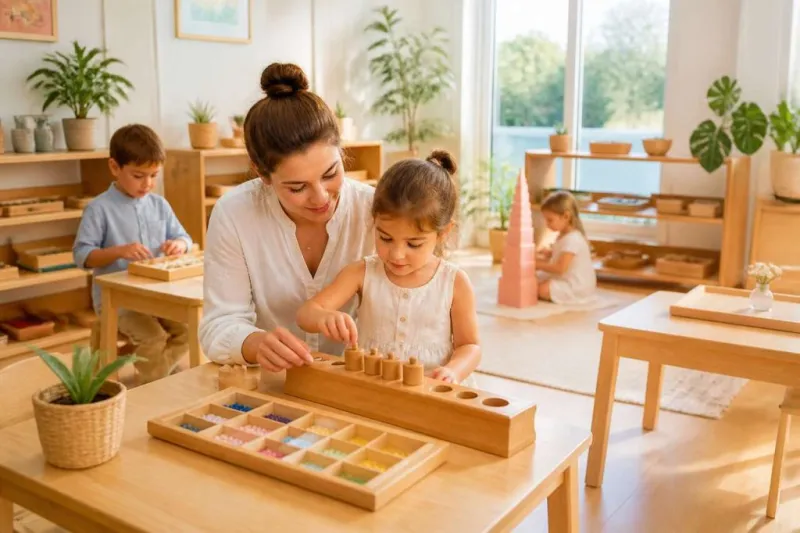
Photo: parent observing montessori nursery classroom children playing, via images.template.net
A useful signpost, not a full map
When parents begin searching for a nursery, the Ofsted grade is often one of the first things they see. It is short, comparable, and easy to find. That is genuinely helpful. A setting that has been judged well by inspectors has usually met important standards around safeguarding, leadership, and the quality of education. Parents should not ignore that.
But a grade is a headline. It cannot tell you what it feels like to be a child in that room on a wet Tuesday in November. It cannot show you how an adult responds when a two-year-old drops a bowl of snack, or how a practitioner speaks to a child who is struggling with a coat zip. It cannot tell you whether the environment quietly invites independence or whether everything is done for children in the name of efficiency.
Choosing a nursery by grade alone is a bit like choosing a home by its front door. The door matters, of course. But you are going to live inside the house. You need to know how the light falls, how the rooms feel, and whether the daily life of the place suits the people in it.
What inspection can see, and what it cannot
Ofsted inspections look at important things. They consider how well children are safeguarded, how leaders set direction, how staff support learning and development, and whether children make progress. These are not small matters. A nursery should be able to talk clearly about them.
But the daily texture of early years is made of smaller moments. How does an adult greet a child who arrives upset? Does a practitioner kneel down to listen, or speak over the child's head? Are children allowed to pour their own water at snack, or is it done for them because it is quicker? When a child is deeply absorbed in play, is that play protected, or is it interrupted every ten minutes for a group activity?
These details do not fit neatly into a single rating. They are also the details that shape a child's experience day after day. A nursery can be perfectly compliant and still feel rushed. Another can be warm and thoughtful while still having areas to improve. The grade is one part of the picture, not the whole frame.
The language adults use
One of the most revealing things to notice in a nursery is how adults speak to children. Not the welcome at the front desk, though that matters too. The ordinary, unscripted language of the room.
Do adults explain what is happening? Do they negotiate with children rather than simply instruct? If a child says no, is there room for a respectful response, or does the adult immediately override it? In a Montessori setting, you would hope to hear language that treats the child as a capable person: 'You have chosen the water tray. The apron is on the hook.' ' You are finding that tricky. I am here if you want help.'
This is not about being soft or endlessly permissive. It is about respect. Children learn an enormous amount from how they are spoken to. They learn whether their ideas matter, whether their feelings are heard, and whether adults are interested in their thinking. A grade cannot tell you whether that happens in the ordinary moments of the day.
Independence in the environment
A Montessori environment is prepared for independence, but the principle is useful for any parent to consider. Look around. Are the coats at child height? Are the cups and plates within reach? Can children choose an activity and return it to the shelf? Is there a real job for them to do, such as watering a plant or wiping a table?
Independence is not a fancy extra. It is how children build competence. When a child can get their own tissues or carry their own bag, they are learning that they are a participant in the room, not a visitor waiting to be served. That feeling of agency is quiet, but it is powerful.
Ask how the setting supports this. What can children do for themselves here? What do adults deliberately not do for them? The answer will tell you a lot about the culture of the nursery, even if it never appears in an inspection report.
Transitions, tears, and the ordinary hard bits
Every nursery has transitions. Arrivals, snack, lunch, nappy changes, sleep, home time. These are the moments where a setting's true colours often show. How are children prepared for change? Is there a warning before an activity ends, or are children suddenly scooped up? How does the room support a child who is finding the morning drop-off difficult?
A thoughtful setting will have a plan. Maybe a key person who greets the child by name. Maybe a calm corner with a familiar book. Maybe a simple routine that helps the child know what comes next. None of this needs to be complicated, but it does need to be consistent.
Ask what happens when a child is upset. Ask how they help a child settle, and how they communicate with parents afterwards. A grade might mention safeguarding or behaviour, but it will not tell you whether the staff will ring you because your child had a wobbly morning, or whether you will only find out at pick-up.
Questions worth asking beyond the badge
If you are visiting a nursery, use the grade as a starting point and then look deeper. A few questions can open up useful conversations:
- How do adults speak to children here when no one is watching? Can I spend time in the room and simply observe?
- What can children do for themselves in this environment? How is the room set up for independence?
- How do you support a child who is struggling with a task, such as putting on shoes or opening a lunchbox?
- What does snack time look like? Is it a relaxed social occasion, or a rushed routine?
- How do you prepare children for transitions, and what happens when a child finds change difficult?
- How do you share information with parents about the small moments, not just the milestones?
- In a Montessori setting, how does the mixed-age group work in practice? How are older children supported to help younger ones without being burdened by it?
These questions do not have single right answers. A setting might be more structured than another, or more free-flowing, and still be excellent. The point is to listen for coherence. Do the answers match what you see? Do the adults seem to believe what they are saying? Is the environment consistent with the philosophy?
Read the room, not just the report
A nursery is a living place. It has a rhythm, a mood, a way of doing things. The best way to understand it is to visit, to watch, and to ask. Notice how children move around the room. Notice whether they seem at ease. Notice whether the adults seem rushed or present. Notice whether the environment looks as though it was designed for children or merely adapted for them.
That does not mean ignoring the Ofsted grade. Use it. Ask about it. If there are areas for improvement, ask how the setting is addressing them. A good nursery will welcome the conversation. But do not let a single badge make the decision for you. The daily life of the place is where your child will spend their days. That life is made of small things, and small things are worth looking at closely.