The Presents That Stay in the Playroom: Choosing Christmas Gifts That Earn Their Place
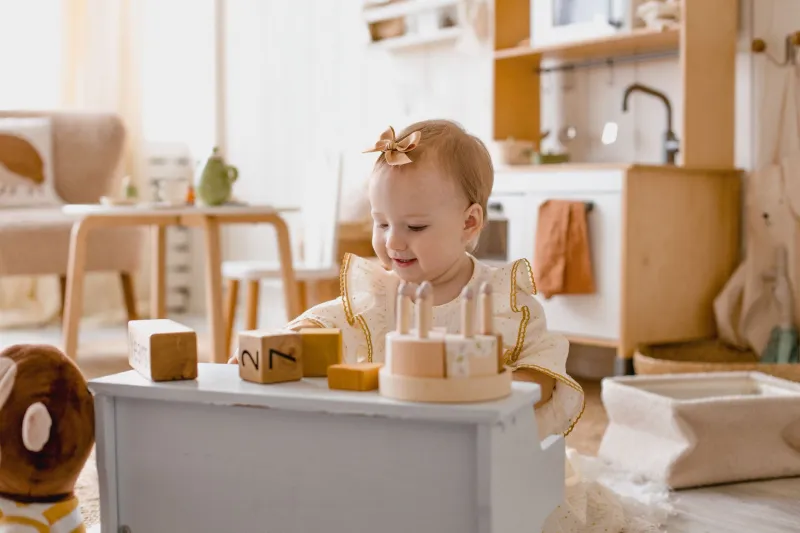
Every January we watch the same thing happen. The tree comes down, the cardboard goes out, the playroom is briefly a room again — and then, quietly, it fills up with things that beeped for a day and a half and haven't been touched since. By February half-term, most of it has become furniture.
That's not a failure of parenting. It's a failure of marketing. The toys that get sold hardest are the ones that look thrilling in an advert, and the toys children actually return to are almost never the same thing. At Little Oaks we spend our days watching what children pick up when nobody is steering them, and it is rarely what the supermarket aisle would suggest.
So here's our honest Christmas list for under-fives. Not a catalogue — more a way of looking at a toy before you hand over your money.
The January problem nobody warns you about
Children under five are not short of entertainment. What they're short of is agency — the chance to do something real, by themselves, and see it work. A toy that performs for them is a small closed loop: press the button, hear the noise, press it again. A toy that they operate is an open one. The difference shows up around the second week of January, when the novelty has gone and only the useful things are left standing.
Four questions before anything earns shelf space
We use a rough version of this with our own resources, and it works just as well on a rainy Saturday in a toy shop.
- Can they use it without me? If it needs an adult to set up, rescue or interpret it, it'll be played with twice.
- Does it invite repetition? Pouring, stacking, filling, tipping out and starting again — the loop matters more than the result.
- Is it real? A wooden apple that can be sliced with velcro is lovely; a real butter knife and a real banana teach more.
- Does it do one thing properly? Toys that do six things tend to do none of them well, and children can tell.
The work of a small child is doing, not watching
In Montessori settings we talk about practical life, which sounds grander than it is. It means carrying, pouring, transferring, sorting, wiping, sweeping, watering, chopping, opening and closing. This is not chores dressed up as play — it's how coordination, concentration and a sense of "I can do this" get built. And it's why the most reliable presents in a nursery are often the least exciting ones on the shelf.
Nine things that are still in use by Easter
- A small jug and a bowl. Ceramic or metal, heavy enough not to tip, small enough for two hands. Add a few centimetres of water and a sponge for the spills and you've bought yourself twenty minutes of deep concentration.
- A child-sized dustpan and brush. Real, not a plastic novelty. Being sent to fetch it after a spill is a promotion, not a punishment.
- A basket of things to sort. Conkers, shells, large buttons, wooden pebbles, pasta shapes. Sorting is the quiet engine behind early maths, and it needs no instructions.
- Tongs and a muffin tin. Transferring pom-poms or cotton wool balls from bowl to tin with tongs is absurdly satisfying at three and four.
- A little watering can. Real water, real plants, real consequence. Put a towel down and let them get it slightly wrong.
- A wooden spoon and a saucepan that's theirs. The best drum kit in the house, and the start of a thousand pretend dinners.
- Chunky chalk and a slab of slate — or just the back step, if you don't mind the mess.
- A proper little bag with a strap. Children this age love carrying things from one room to another. Give them something worthy of the job.
- A book they'll ask for until you hide it. Repetition isn't a bug; it's the whole point.
Batteries, briefly
We're not anti-technology, and we're not going to pretend no flashing toy has ever been loved. But notice what happens when a toy talks: the child stops. The toy has taken the interesting part. A toy that waits — that sits there until a small person decides what it is today — hands the interesting part back.
Fewer things, more ritual
There's an old rhyme doing the rounds that goes something they want, something they need, something to wear, something to read. It's a decent cage for the gift-buying instinct, and it scales beautifully to grandparents. One good thing, opened slowly, with the paper kept for cutting up afterwards, will land better than a sack of small things opened in a blur. Consider also a present that isn't a thing at all: a trip on the bus, a morning at the allotment, a voucher for a Saturday walk with a grandparent and a flask.
Secondhand is not a compromise
Most of the best open-ended toys in our nursery would be unrecognisable in a gift shop: wooden bowls from a charity shop, a set of metal measuring spoons, a battered tin with a lid. Car boot sales, local selling pages and charity shops are full of solid wood and good metal at a fiver, and they age better than anything moulded in a factory. Wash it, check for splinters and sharp edges, and you're done.
The grey Tuesday test
The real measure of a Christmas present isn't the noise it makes on the twenty-fifth. It's whether a child, bored on a wet Tuesday in February, with no adult directing the game, wanders over and picks it up. Buy for that child, not the one in the advert, and you'll be surprised how little you need to buy at all.